
Article R415-9 of the Highway Code addresses the issue unambiguously: any vehicle emerging from a non-public access – private garage, dirt road, parking area – must yield to all users traveling on public roads. This obligation of priority, often confused with a mere recommendation for caution, forms the legal basis around which the distances and constraints related to garage exits are structured.
Article R415-9 and priority when exiting a garage: an obligation of result
Confusion is common in forums and public articles. It is often stated, “be careful when exiting your garage,” as if it were a piece of common sense advice. Article R415-9 imposes much more: the driver must be able to stop on the spot before crossing the sidewalk or cutting into the road.
In practical terms, this means that visibility from inside the garage or from the property line conditions the compliance of the access. A garage whose exit opens blindly onto a busy sidewalk or a two-way street poses a regulatory problem that mere distance from the curb does not resolve. We recommend systematically checking the available field of vision even before sizing the depth of the clearance.
To delve deeper into the technical constraints of clearance and setback in front of a garage, it is useful to consult the Déclic Auto website, which details these parameters according to common configurations.
Inconvenient parking in front of a vehicle access: article R417-10 of the Highway Code
The prohibition on parking in front of a vehicle access applies to everyone, including the garage owner. This is the point we find most misunderstood. Article R417-10 qualifies any parking in front of the vehicle accesses of adjacent buildings as inconvenient, without allowing any exceptions related to vehicle or property ownership.
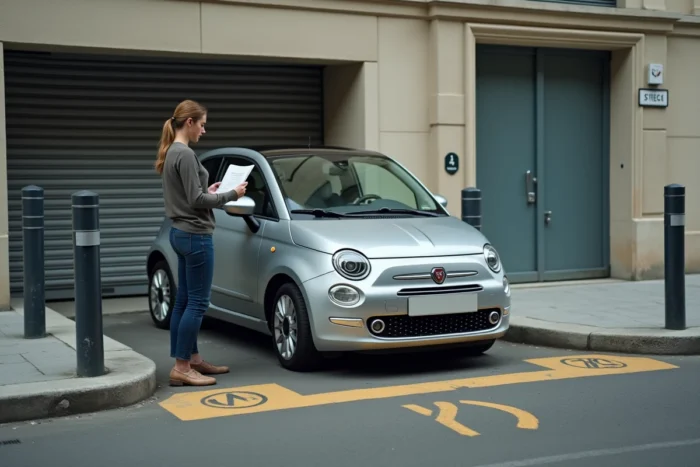
A property owner parking their own car in front of their garage, on public road, commits the same offense as a third party. The fine falls under the fourth class. Placing a “owner” sign or writing their license plate number on a wall-mounted support does not create any special rights: this practice has no legal value and does not prevent either fines or towing.
Ground marking and horizontal signage
The yellow marking in front of garage exits, in accordance with the decree of November 24, 1967, indicates the no-parking zone. Its presence is not mandatory for the offense to be constituted: the vehicle access itself is sufficient to establish the fine. The marking facilitates observation by agents, but its absence does not protect the offender.
Local Urban Plan (PLU) and setback distance: what urban planning rules add to the Highway Code
The Highway Code governs the behavior of users on public roads. The rules regarding physical distance between the garage and the property line fall under the local urban plan (PLU) of the municipality. These two frameworks overlap without substituting for one another.
The PLU may impose a minimum setback between the garage facade and the street alignment. This distance varies from one municipality to another and sometimes from one sector to another within the same city. Some PLUs also set requirements regarding the slope of the access ramp, the minimum width of the opening, or the exit angle relative to the roadway.
- The setback from the public road is defined in the provisions of the PLU specific to each zone (UA, UB, UC, etc.) and can range from zero to several meters depending on urban density
- The minimum width of the vehicle access may be prescribed by the municipal road regulations, independently of the PLU
- Obtaining a building permit or a prior declaration for a garage involves verifying compliance with these distances by the instructing service
No national standard sets a universal setback distance for a garage. The frequent references to “five meters minimum” correspond to a common technical recommendation, not to a legal text. This value generally allows parking a vehicle in front of the garage without encroaching on public domain, but it does not have a uniform regulatory basis.
Recourse in case of garage exit blockage
When a third-party vehicle blocks access, the procedure follows a precise order. The first reflex should be to contact the municipal police or the gendarmerie, the only authorities authorized to observe the offense of inconvenient parking and to initiate a towing procedure.
- Fines can be issued without the garage owner having filed a complaint: the offense is observed ex officio
- Towing is possible as long as the vehicle prevents access to a vehicle entry, even in the absence of ground marking
- In case of recurrence (a neighbor regularly parking in front of your garage), a report followed by a summary action before the judicial court can lead to an injunction
- Installing a surveillance camera aimed at the public road is subject to declaration and can only film your property, unless authorized by the prefecture
Resorting to a bailiff to document repeated blockage constitutes the most solid step before any legal action. The bailiff’s report has probative value before the court and documents the frequency, times, and duration of the illegal parking.
Private property and public domain: the boundary not to be confused
The garage exit overlaps two distinct legal regimes. On private property, the owner is free to organize their access in compliance with the PLU. As soon as the vehicle crosses the property line and enters the sidewalk or roadway, the Highway Code applies fully.
This distinction explains why a garage perfectly compliant with the building permit can nonetheless pose exit problems related to visibility or the narrowness of the road. Urban planning law validates the construction, while the Highway Code regulates daily use. Urban compliance does not exempt from respecting article R415-9.