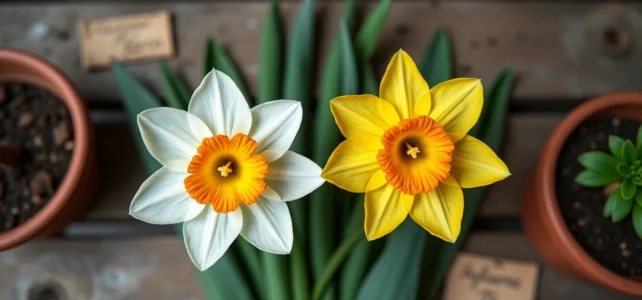
We all fall into the same trap in spring: a clump of yellow flowers grows at the back of the garden, and we hesitate between “daffodil” and “narcissus” without quite knowing what distinguishes them. The usual shortcut (“yellow = daffodil, white = narcissus”) doesn’t hold up as soon as we observe the plants closely. The distinction relies on precise botanical criteria, visible to the naked eye if you know where to look.
Foliage and stem: the real markers for identifying daffodils and narcissus
Before even looking at the flower, you save time by observing the foliage. This is the most reliable criterion in the field, much more than the color of the petals.
The leaves of the daffodil are narrow, almost cylindrical, resembling bulrush stems (hence its name). They grow in tight clumps, with a somewhat fleshy appearance. Common horticultural narcissus, on the other hand, have flat, ribbon-like leaves that are significantly wider.
This detail often suffices to make a distinction. When you have both plants side by side, the difference is obvious: on one side, leaves that look like fine rounded needles, on the other, flattened foliage reminiscent of a miniature leek.
To delve deeper into the difference between daffodils and narcissus in the garden, you can also count the flowers per stem. Daffodils (Narcissus jonquilla and its hybrids) often bear several small flowers grouped on the same stem. Classic garden narcissus, trumpet type, generally have only one larger flower per stem.
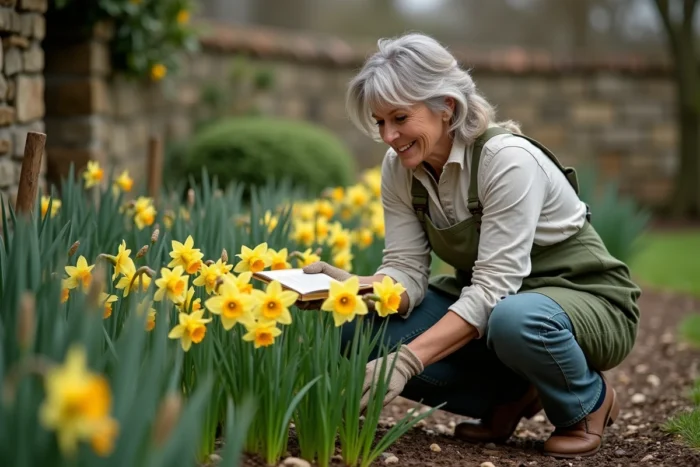
Narcissus jonquilla: why all daffodils are narcissus
The confusion comes from a vocabulary issue, not a botanical one. All daffodils belong to the genus Narcissus, but the reverse is not true. The term daffodil specifically refers to the species Narcissus jonquilla and its close hybrids.
In everyday language, “daffodil” is used to refer to almost any yellow narcissus. Garden centers contribute to the confusion by sometimes labeling large trumpet narcissus as “daffodil,” which have nothing to do with the jonquilla species. The result: you buy bulbs thinking you’re planting daffodils, and you end up with perfectly classic trumpet narcissus.
To clarify, the international horticultural classification divides narcissus into several divisions. Daffodils in the strict sense are found in the jonquilla division, characterized by stems bearing several flowers and cylindrical foliage. Trumpet narcissus, the most sold, belong to another division.
Fragrance as a field indicator
When you’re still unsure after observing leaves and flowers, the fragrance often settles the debate. Daffodils emit a strong, sweet scent that is recognizable from a distance. Many large trumpet narcissus are either lightly scented or completely odorless.
You can test this directly in the garden or at a garden center: bring your nose close to a bouquet of yellow trumpet narcissus, then to a group of small jonquilla flowers. The olfactory difference is clear. Feedback on this point varies according to hybrid varieties, but for the typical species, it’s a reliable marker.
Recognizing daffodils and narcissus: the field checklist
Rather than memorizing Latin names, you can rely on four observable criteria in just a few seconds in the garden:
- The leaves are fine and cylindrical (like bulrush): it’s probably a daffodil. Flat and wide leaves indicate a classic horticultural narcissus.
- The stem bears several small grouped flowers: this is a typical trait of jonquilla. A single large flower per stem indicates a trumpet or large-cupped narcissus.
- The fragrance is pronounced and sweet: daffodils are significantly more fragrant than most common garden narcissus.
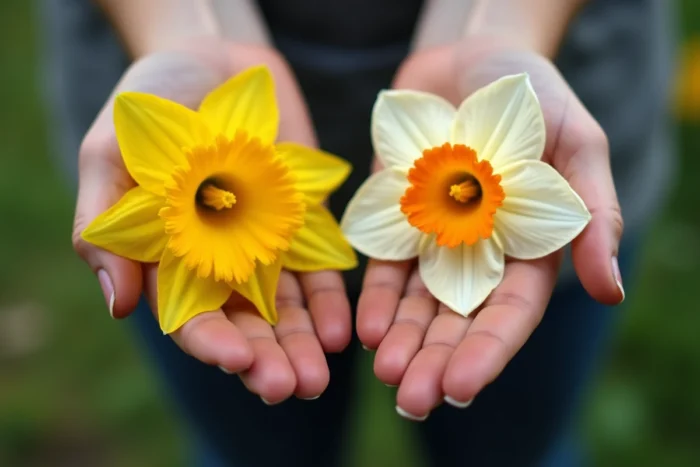
- The trumpet is short compared to the petals: in daffodils, the crown (central part) is generally small and flared, while trumpet narcissus have a crown as long as the petals.
One criterion alone is not always sufficient, especially with modern hybrids that mix characteristics. Cross-referencing two or three of these markers gives a reliable result in the vast majority of cases.
Narcissus and daffodil bulbs: what changes at planting
Practically speaking, the cultivation remains very similar. Bulbs are planted in the fall, in well-drained soil, pointed end up. But a few differences deserve attention.
Daffodils tolerate dry and warm soils better than many horticultural narcissus. This makes sense: Narcissus jonquilla is native to the Mediterranean region. In a south-facing garden with stony soil, daffodils often establish themselves better than large trumpet narcissus, which prefer cooler soil.
Daffodil flowering generally occurs a bit later in the season than that of early trumpet narcissus. By planting both, you extend the flowering period of the garden by several weeks, which is a real advantage for spring beds.
Naturalization and return year after year
Both naturalize well, but daffodils tend to form dense clumps more quickly. Each bulb produces several flowering stems, and the multiplication is generous. For a natural prairie effect, daffodils planted in groups of ten bulbs or more yield a spectacular result by the second year.
Large trumpet narcissus, on the other hand, produce larger but fewer flowers per clump. They are preferred at the edge or in pots, where their size is better showcased.
The distinction between daffodils and narcissus thus relies on concrete details (foliage, number of flowers, fragrance, crown shape) rather than just color. Once these markers are in mind, you won’t confuse the two in the garden, and you’ll choose your bulbs with knowledge.