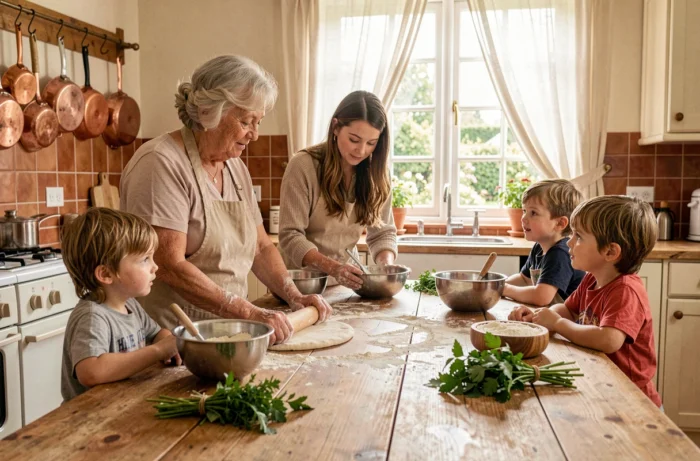
Cooking with family raises a rarely asked question: can the same dish truly be suitable for a four-year-old and an adult, without preparing two separate menus? Nutritional data and food safety constraints show that yes, provided a few specific parameters are adjusted. This article measures the gaps between what family recipes promise and what health guidelines require.
Food safety by age: the restrictions that family recipes ignore
Most family meal ideas circulate without mentioning the age-related limits for children. These restrictions are not trivial.
| Food | Restriction | Age concerned |
|---|---|---|
| Whole nuts (walnuts, almonds, hazelnuts) | Choking hazard | Under 6 years |
| Raw milk and raw milk cheeses | Not recommended (except for cooked pressed cheeses) | Under 5 years |
| Meat, fish, eggs or poultry | One portion per day (lunch or dinner) | 4 to 11 years |
These guidelines, relayed by 60 Millions de consommateurs and Santé publique France, change the composition of a gratin or quiche as soon as a child under five is at the table. A vegetable gratin with raw milk cheese, a common recipe on culinary websites, is not suitable for this audience.
In practical terms, checking the cheese label before grating takes a few seconds and avoids a real risk. Cooked pressed cheeses (comté, beaufort, aged gruyère) remain allowed: they provide a direct alternative in most gratin and savory tart recipes.
Several recipes shared on the Foodies and Family website specifically offer family dishes that can be adapted according to age, incorporating these constraints without complicating preparation.

Balanced family meals: adjusting quantities rather than the menu
The idea of preparing a single dish for the whole family works, but the quantities served to a four-year-old and a teenager cannot be the same. The recommendations from 60 Millions de consommateurs call for vegetables, starches, or legumes at every meal, and only one portion of animal protein per day for children aged 4 to 11.
This means that a salmon pasta dish served in the evening requires that no meat or fish was offered at lunch. The classic reflex of chicken at noon followed by fish in the evening exceeds this recommendation.
Respecting appetite without forcing
Santé publique France recommends providing a regular and varied framework, without forcing the child to finish their plate. This approach opposes the logic of “finish your plate,” which is still common. In family cooking, this means serving modest portions and allowing the child to help themselves.
A typical family dish, like a seasonal vegetable quiche, allows for this flexibility: each guest cuts the portion they want. In contrast, a saucy dish served by ladle makes portion control less intuitive for a young child.
Food waste prevention in family cooking and sorting of organic waste starting in 2024
The AGEC law has generalized the sorting of organic waste at the start of January 2024. For a family that cooks regularly, vegetable peels, eggshells, and meal leftovers fall under this regulatory framework.
Integrating waste prevention into family cooking is not just a simple ecological gesture. It is a legal obligation that changes the concrete organization of meal preparation.
- Carrot, zucchini, and potato peels go into the organic waste bin, not the regular trash.
- Leftover gratin or tart can be saved for a meal the next day, reducing the volume of food waste.
- Children who participate in sorting in the kitchen develop a reflex that extends beyond the meal.
Cooking a family dish by adjusting the quantities to the actual number of diners remains the most effective waste prevention lever. A gratin recipe for four people prepared for six will systematically generate leftovers.
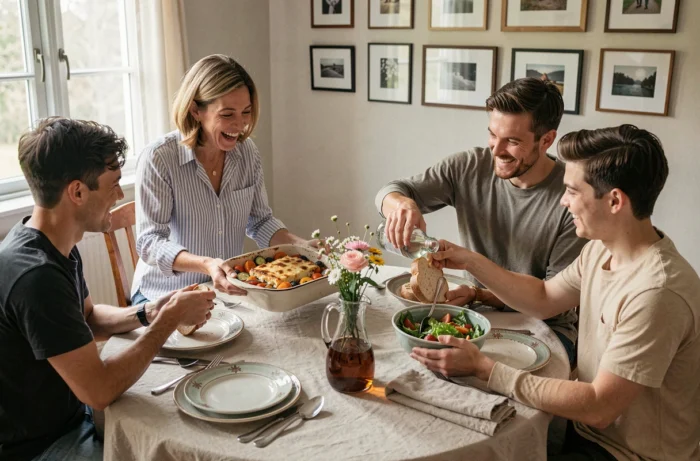
Family oven recipes: why gratins and tarts dominate
The oven simplifies family cooking for a measurable reason: the active preparation time rarely exceeds fifteen to twenty minutes for a vegetable gratin or a quiche. The rest is passive cooking time.
Oven recipes have another advantage for families with children: they do not require constant supervision of a pan or pot. A parent can help with homework while the dish cooks.
Three versatile bases to vary meals
- Pie crust (shortcrust or puff pastry) can accommodate both tomatoes and cheese as well as a leek-bacon mixture. One base, several different dinners throughout the week.
- Pasta gratin can be adapted with available vegetables: zucchini in summer, spinach or leeks in winter. Adding a beaten egg to the béchamel increases the protein content without adding a second animal source.
- The crustless quiche (batter poured directly into a buttered dish) further reduces preparation and suits children who do not like crust.
These three recipe formats share a common point: they can be cut into adjustable portions, aligning with the logic of adapting quantities according to age.
Family cooking benefits from being analyzed in terms of real constraints rather than just desires. Age-related dietary restrictions, portion recommendations, and the obligation to sort organic waste form a framework that, once integrated, simplifies daily choices. A well-thought-out single dish nourishes the entire table without compromising safety.