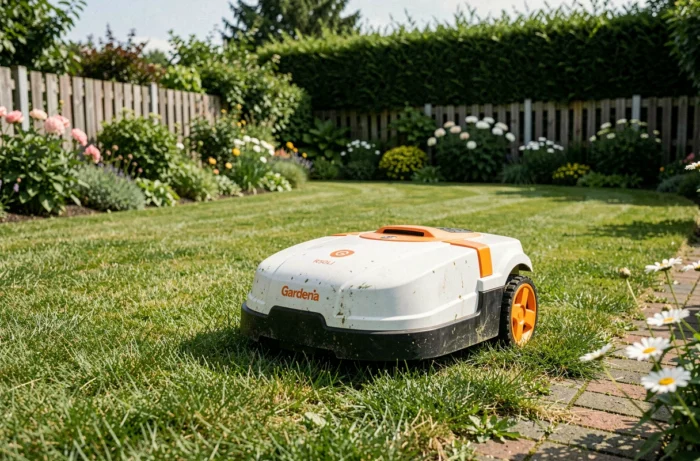
The Gardena R50Li is a perimeter wire robotic lawn mower designed for small lawns. Its mowing system relies on pivoting blades powered by a lithium-ion battery, with automatic return to the charging station. This model, positioned in the low price segment, remains one of the most accessible robots in the Gardena range.
Perimeter wire of the R50Li: a technology to understand before buying
The R50Li operates with a buried or ground-fixed perimeter wire that defines the mowing area. The robot detects the electrical signal emitted by this wire to know where to stop. This technology, reliable for years, differs radically from recent vision or GPS navigation systems offered by some newer Gardena models (Sileno range, for example).
Installing the wire takes time. It must be laid around the entire perimeter of the lawn, around flower beds, trees, and fixed obstacles. A cut or poor connection is enough to interrupt the robot’s operation. Repair kits for the wire are still available, confirming that this maintenance point is part of the product’s everyday life.
For those who accept this initial constraint, the perimeter wire offers precise and predictable delimitation. The robot does not cross the boundaries, even on slightly sloped terrain. Before investing, it is better to measure the complexity of your garden: the more islands, narrow passages, or corners there are, the longer the wire installation will take. You can find out everything about the Gardena R50Li on jardibot.fr to assess if this setup suits your terrain.
Wildlife protection: a forgotten angle for the Gardena robotic mower
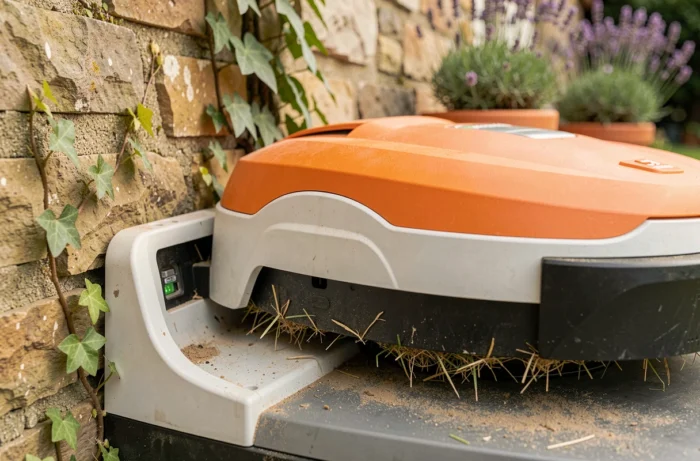
Commercial content on robotic mowers rarely mentions the impact on small wildlife. The R50Li is equipped with shock sensors that trigger a change of direction upon contact with an obstacle. This mechanism protects the robot and hard objects but does not guarantee the detection of an animal before physical contact.
No manufacturer datasheet reviewed provides a standardized detection test on a hedgehog. This observation applies to the R50Li as well as to most robots of this generation, which lack vision or LiDAR systems.
Concrete recommendations exist to limit risks:
- Schedule mowing exclusively during the day when hedgehogs and other small mammals are less active
- Increase the cutting height to reduce the severity of any potential contact with an animal on the ground
- Create forbidden zones around hedges, wood piles, and refuge spaces by adjusting the perimeter wire layout
Nocturnal mowing, often touted as a practical advantage, poses a direct risk to wildlife. On an older model without advanced sensors, it is better to avoid it.
Programming and autonomy of the Gardena R50Li in daily use
Programming the R50Li is done through an integrated control panel, without a mobile app or Wi-Fi connection. The days and times for mowing are set directly on the robot. This simplicity appeals to users who do not want to rely on a smartphone or a home network.
The lithium-ion battery’s autonomy allows the robot to mow for a significant duration before returning to its charging station. The charge-mow-return cycle is fully automated: the robot manages its trips to the base on its own without intervention.
The covered area remains limited, advertised for small-sized gardens. For a lawn that exceeds this threshold, the robot will multiply cycles and take longer to cover the entire area, which wears the battery out more quickly in the long term.
Noise level: an asset for daytime mowing
Robotic mowers produce significantly less noise than a gas mower. The R50Li is no exception. This low noise level allows for scheduling mowing during the day without disturbing the neighbors, which aligns with the recommendation not to mow at night to protect wildlife.

Limitations of the R50Li compared to recent Sileno models
Gardena has significantly renewed its range since the release of the R50Li. The Sileno city and Sileno models incorporate features absent on the R50Li: Bluetooth or Wi-Fi connectivity, Gardena smart app, frost sensors, and automatically managed narrow passages.
The table below summarizes the structural differences:
| Criterion | R50Li | Sileno city / Sileno |
| Navigation | Perimeter wire only | Perimeter wire + smart corridors |
| Programming | Embedded panel | Mobile app + panel |
| Connectivity | None | Bluetooth / Wi-Fi depending on model |
| Frost sensor | No | Yes on some models |
| Price | Among the lowest on the market | Mid to high segment |
The R50Li retains a clear advantage in price. For a small garden without complex configuration, the value for money remains its main argument against connected models. The lack of connectivity also reduces the risks of software failure or dependence on a third-party app.
A robotic mower without Wi-Fi is not an obsolete robot. For a small rectangular lawn, the R50Li fulfills its function without technological overhead. The choice depends on the terrain, budget, and tolerance for the installation of the perimeter wire, which remains the only truly constraining step of this model.