Velvet during the day, ecological claims under regulatory pressure, repair as a style gesture: the themes redefining women’s wardrobes this season go far beyond just color considerations. An analysis of concrete levers to refine a coherent, sustainable, and personal wardrobe.
Velvet in casual contexts: textile constraints and material combinations
Velvet is moving away from being exclusively formal. The autumn-winter 2026 collections showcase it in jackets worn over raw denim or in midi skirts paired with ribbed sweaters. The technical challenge lies in the management of texture contrasts: a short-pile velvet (known as “milleraies”) handles mixing with dry fabrics like denim better than a silk velvet, which is more fragile and shinier.
Three points to check before incorporating a velvet piece into a daytime outfit:
- The direction of the pile: brushed downward, velvet appears lighter and reflects less light, which limits the “dressy” effect.
- The weight of the fabric: a cotton velvet can be worn daily without wrinkling as quickly as a fine synthetic velvet.
- Care: vertical steam is a better alternative to an iron, which flattens the pile and creates irreversible matte areas.
A burgundy or chocolate velvet, worn with structured sneakers and a straight coat, creates a seasonal silhouette without falling into evening wear. The reflex to avoid: layering two velvet pieces, which visually and physically weighs down the outfit.
Sustainable claims on women’s fashion labels: what the European framework changes
For those following women’s fashion on Mam’Zell Plume or other specialized media, the term “eco-responsible” on a label has already raised questions. The European regulatory framework currently being deployed makes these claims riskier for brands: any ecological mention must be based on verifiable evidence, under penalty of sanctions.
The digital textile passport mandated by the ESPR regulation (Ecodesign for Sustainable Products Regulation) will require, category by category, a base of information accessible to consumers: exact composition, country of manufacture, sustainability data. The final requirements will vary by product type, but the direction is clear.
In practice, this changes the way to choose a piece presented as “sustainable.” Looking for an identifiable third-party label (GOTS, OEKO-TEX) remains more reliable than trusting vague marketing language. A garment without precise certification is not necessarily bad, but its green claim holds no legal value.
Textile repair and women’s style: prolonging a piece rather than replacing it
Repairing clothes is common in households, but the services offered by brands themselves remain largely underutilized. According to a report cited by Yahoo Lifestyle, the majority of respondents repair on their own, through a friend, or via an independent tailor. Many are unaware that some brands offer an integrated repair service.
From a stylistic perspective, repairing a favorite piece changes the relationship with the wardrobe. A jacket with a replaced lining or jeans with a hem taken up become custom pieces, tailored to the body shape and actual wear.
Some repair actions that enhance the longevity of a garment:
- Reinforcing the inseam stitches on regularly worn pants before the tear extends.
- Replacing the buttons on a blazer with horn or brushed metal models, updating the piece without investing in a new garment.
- Reweaving a wool sweater with a knit stitch rather than a classic stitch for an almost invisible finish on natural fibers.
Autumn colors and building cohesive looks
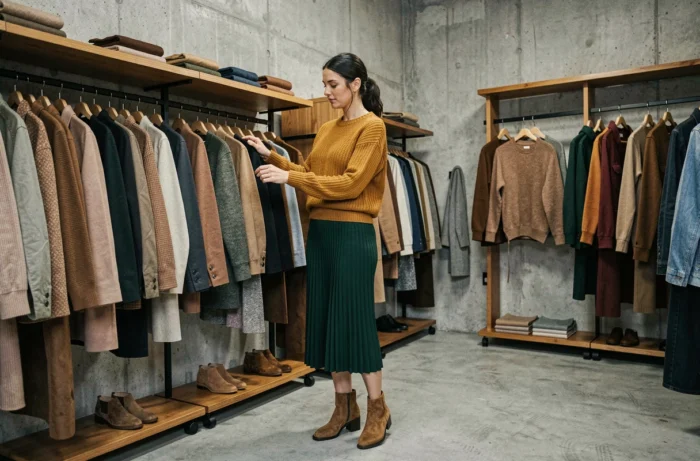
Burgundy, chocolate, and khaki dominate the season’s palettes. Their common point: they are medium-value colors, neither too light nor too dark, making them compatible with each other without creating harsh contrasts.
Building a look around these tones requires thinking in terms of blocks of brightness rather than “matching colors.” Chocolate pants work with a khaki top if both pieces share a similar depth of tone. Adding a lighter piece (an ecru, a light beige) creates the point of light that prevents the silhouette from flattening.
The pink trend observed in spring-summer persists in a muted form: a powdery pink accessory (bag, scarf) can punctuate an autumn outfit without looking out of season. A single colorful accessory on a neutral base remains the safest method to test a color without heavy wardrobe commitment.
Seasonal accessories: focusing on the quality of a piece
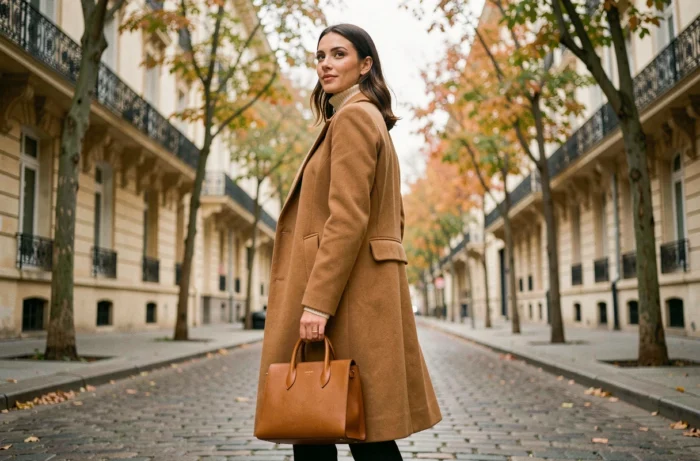
Rather than accumulating trendy accessories, a single well-chosen accessory structures an entire look. A textured leather belt on a straight coat redefines the waist. A fine wool scarf tied low replaces a bulky necklace under a turtleneck.
Leather, omnipresent in collections this season, is best selected in a matte finish rather than glossy for daily use. The natural patina of full-grain leather improves over time, while coated leather peels after a few months.
This season’s women’s wardrobe is less about accumulating new pieces and more about the precision of choices. A well-matched velvet, a label read with discernment, a repair that extends the life of a garment: these actions build a more personal style than any fleeting trend.