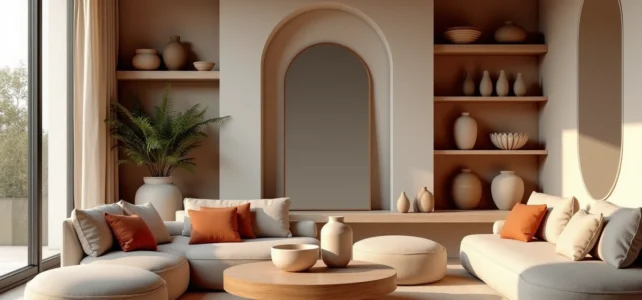
Enhancing an interior in 2026 involves precise technical choices, not just an accumulation of trends. The ten ideas that follow each target a concrete lever: furniture shape, storage management, sensory treatment of space. We have selected them for their measurable visual impact and compatibility with various surfaces.
1. Round pebble-shaped table to break the rigidity of the living room
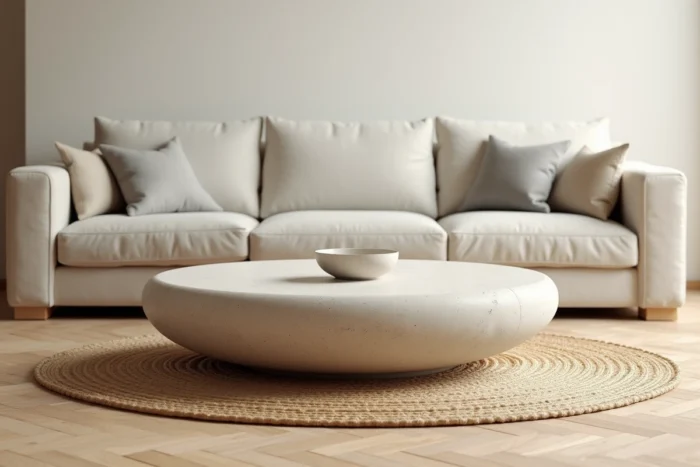
Square tables are losing ground to rounded tops, whether pebble-shaped or elliptical. This shift towards curves is not just aesthetic: a table without corners frees up circulation in rooms smaller than twenty square meters and reduces dead zones in the layout.
We recommend a solid wood top with softened edges rather than a glass model, which shows marks more easily. Oiled finishes retain the grain better over the long term than polyurethane varnish.
For those looking to delve deeper into this search for fluid-lined furniture, complementary references are available at ambiance-et-deco.fr with a wide selection of matching decorative objects.
2. Buffet with hidden capacity for invisible storage
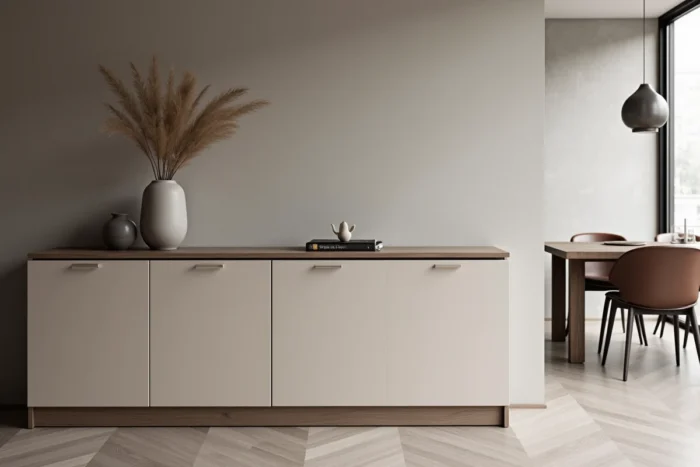
Invisible storage redefines volumes without overloading. Next-generation buffets hide a storage capacity far greater than their profile suggests, thanks to drawers on full-extension slides and adjustable backs.
The principle also applies to storage benches and double-bottomed seating. Each piece of furniture plays a dual role, eliminating the need for open shelves that are often difficult to keep organized.
3. Curved fronts on living room furniture
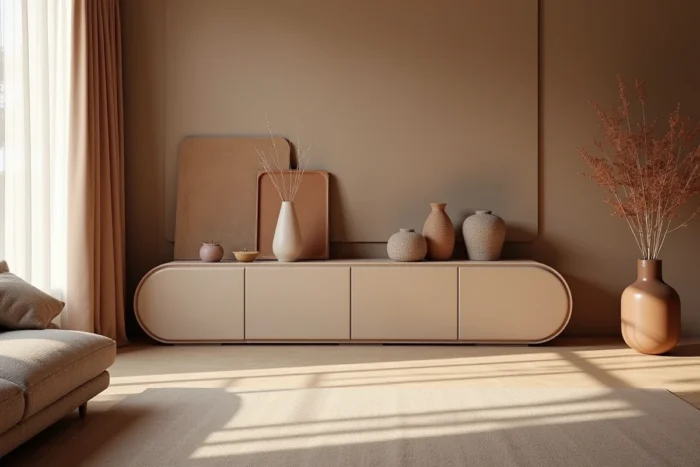
Convex or concave fronts on sideboards and TV units create a play of shadows that flat surfaces do not produce. The so-called curvy living room is distinguished by this modulation of natural light on the volumes of the furniture.
The technical constraint lies in machining: a curved MDF panel requires flexible veneer (thin sliced oak or flexible HPL laminate). Curved solid wood fronts are significantly more expensive and require a specialized cabinetmaker.
4. Layered lighting to create an immersive interior
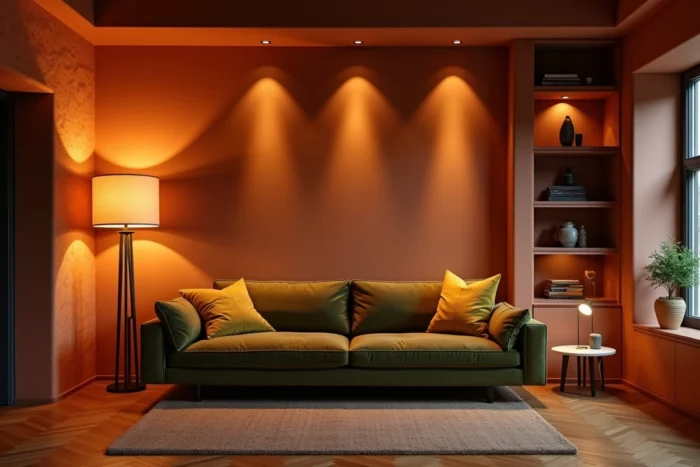
Working with light in three layers (general lighting, accent lighting, low ambient lighting) transforms a standard living room into a sensory space. The trend towards sensory and immersive interiors largely relies on this principle of light layering.
A dimmer for each circuit allows for modulation of intensity according to the time of day. LED strips recessed under low furniture or behind a headboard produce an indirect halo that visually enlarges the room.
5. Headboard with integrated storage for a streamlined bedroom
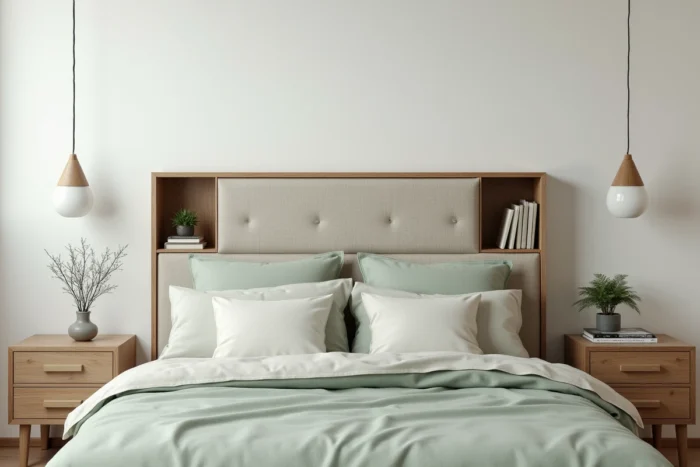
The headboard is no longer just a decorative panel. Models with side niches and a top shelf replace bedside tables, freeing up usable floor space on each side of the bed.
Three criteria to check before purchase:
- Depth of niches: a minimum of 15 cm is necessary to accommodate a book or an alarm clock without overhang
- Wall mounting: suspended models facilitate vacuuming and eliminate a bulky effect
- Textile covering: a boucle fabric or corduroy adds a tactile dimension that wood alone does not provide
6. Modular decoration to adapt the space daily
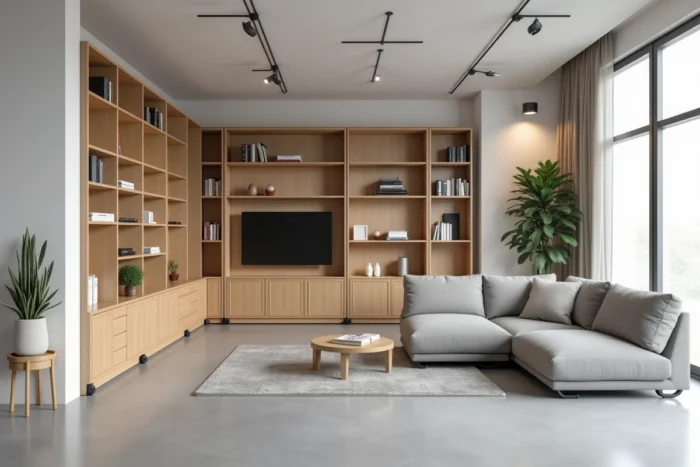
Modular decor allows for reconfiguring a room without buying new furniture. Repositionable shelves, removable partitions, combinable seating: the principle relies on reversible fixings and compatible modules.
This system is particularly suitable for compact living spaces where the same room serves as an office during the day and a living room in the evening. We observe that manufacturers are developing ranges with standardized connectors, making elements interchangeable from one collection to another.
7. Textured raw materials as a punctuated touch
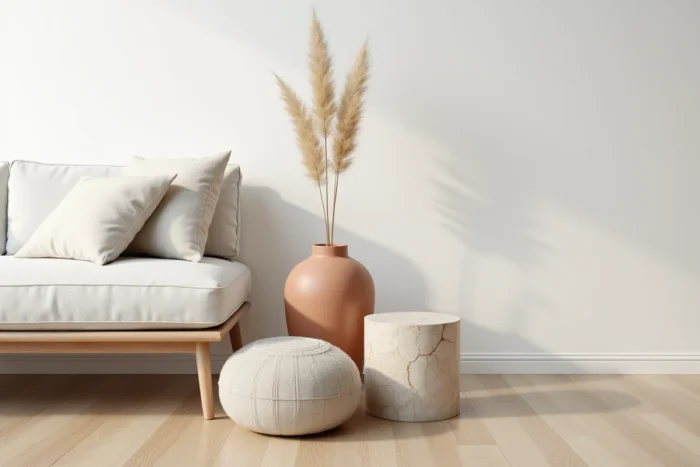
Unpolished travertine, brushed oak, or thick linen bring a roughness that breaks the monotony of smooth surfaces. The sensory approach to decoration relies on this tactile contrast between polished and raw materials in the same room.
The dosage rule: limit the raw material to a single surface per room (a wall, a floor, a piece of furniture). Beyond that, the rustic effect overshadows the sought-after sophistication. A single wall of stone or textured plaster is enough to anchor the identity of a room.
8. Artistic craftsmanship as a signature piece
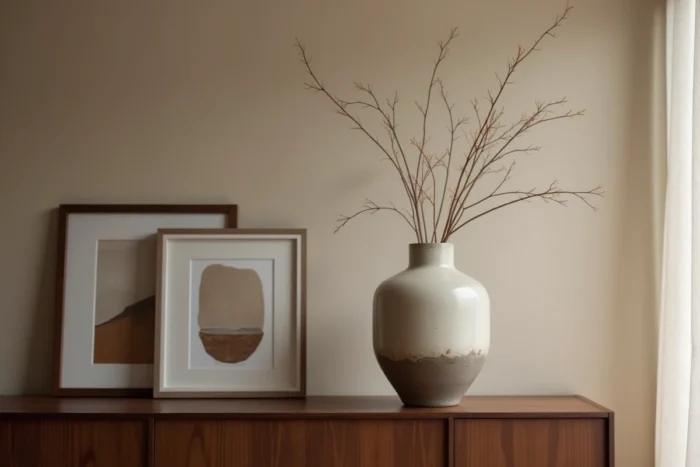
The major trends in artistic craftsmanship in 2026 converge towards unique pieces that serve as focal points. A hand-turned ceramic light fixture or a forged metal console fulfills this role better than an accumulation of small objects.
Choosing a handcrafted piece requires simplifying the rest of the decor around it. A neutral background (off-white wall, light mineral plaster) highlights the uniqueness of the object without competing visually.
9. Terracotta and ochre palette for controlled warmth
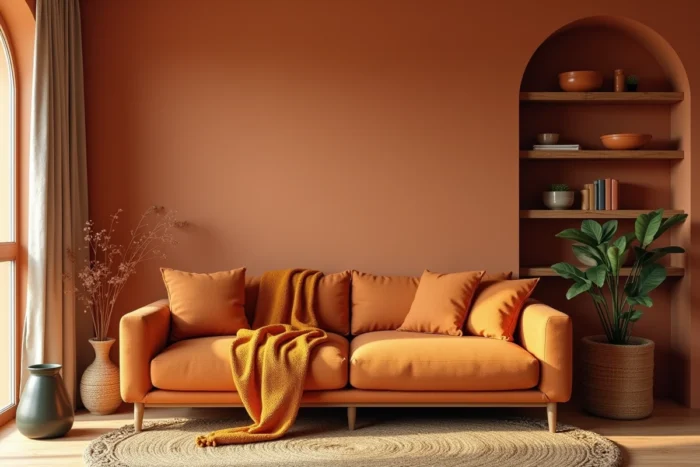
Earth tones remain a reliable lever for warming up an interior without falling into saturation. Terracotta works as a flat color on an accent wall, while ochre is better dosed in textiles (cushions, curtains, rugs).
Combining terracotta and light wood avoids the pitfall of a too-dark interior. A bleached oak floor or pale gray waxed concrete balances the warmth of the walls and maintains overall brightness.
10. Architectural mirrors to restructure depth
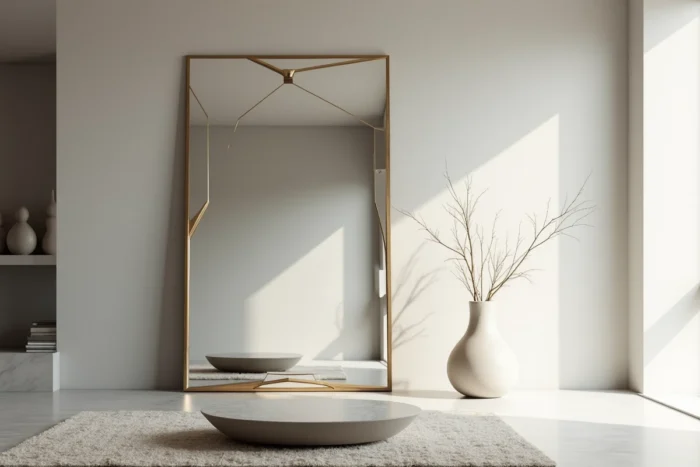
A large mirror placed on the floor or mounted on a full wall does more than reflect light. It restructures the perception of volume by doubling the vanishing point, correcting the proportions of narrow hallways or elongated rooms.
Arch or ogive shapes add an architectural dimension absent from classic rectangular mirrors. The frame is as important as the reflective surface: a brushed metal or solid wood edging transforms the object into a structural element of the wall.
Each of these ten ideas acts on a specific parameter: shape, light, texture, volume, or storage. Combining two or three in the same room produces a coherent result, provided that two strong effects are never layered on the same surface.