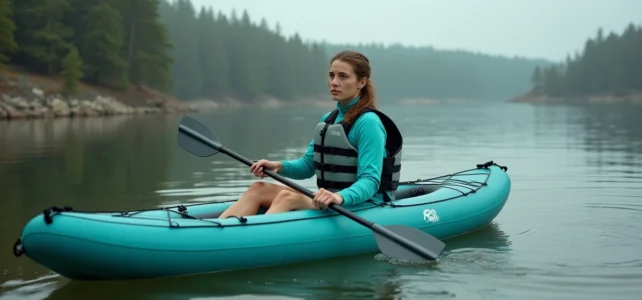
The Lagoon 1 from Advanced Elements is based on a hybrid architecture that sets it apart from most entry-level inflatable kayaks. Its rigid panels integrated at the bow and stern are not a marketing gimmick: they structure the waterline and correct the hydrodynamic profile that the tubes alone cannot maintain. Here, we analyze this model from a technical, regulatory, and practical perspective, after several outings in real conditions.
Hybrid structure of the Lagoon 1: rigid panels and covered air chamber
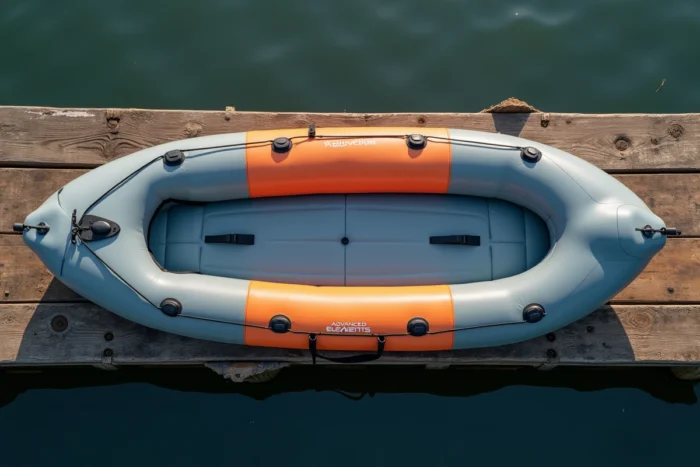
The design of the Lagoon 1 combines a PVC-polyester outer shell and internal air chambers protected by a tube cover. This cover serves a dual purpose: it adds longitudinal rigidity and protects the bladder from abrasion against the external hull.
The rigid panels at the ends define a correct water entry angle for an inflatable of this category. Without them, the rounded bow typical of inflatable kayaks creates frontal resistance that forces you to exert effort on every paddle stroke. The Lagoon 1 does not compete with a rigid kayak in terms of glide, but its structural panels significantly reduce the propulsion effort compared to an all-soft model like an Intex Explorer.
We compiled our review of the Advanced Elements Lagoon 1 kayak by directly comparing it to inflatables without internal framing, and the difference in tracking is tangible from the first lengths.
Twistlok valves and inflation pressure
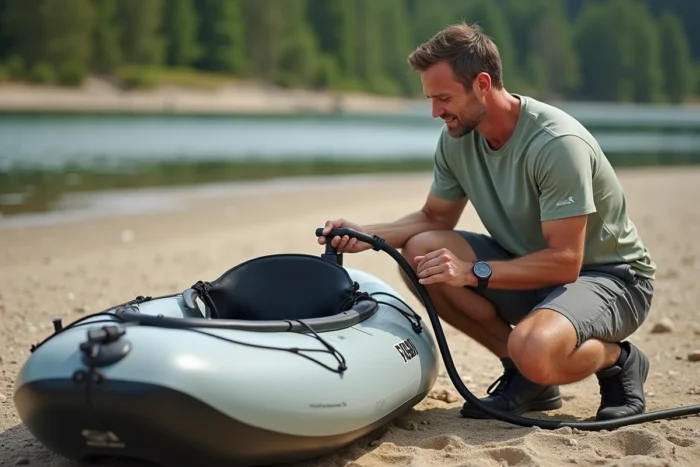
The Lagoon 1 uses Twistlok valves combined with high-flow spring valves. Full inflation takes less than ten minutes with a double-action manual pump. The point to watch: the final pressure. Insufficient inflation leaves the hull soft and degrades directional behavior. You need to inflate until you feel a firm resistance on the pump, without waiting for a pressure gauge that the kit does not provide.
Behavior in calm water and limits in degraded conditions
On a lake or protected body of water, the Lagoon 1 is stable and predictable. The width of the hull promotes primary stability: you can lean to grab an object without feeling unstable. The tracking fins attached under the hull maintain a reasonable course as long as the wind remains light.
As soon as the wind exceeds about fifteen knots or the chop sets in, the situation changes. The exposed surface of the side tubes acts like a sail, and the drift becomes difficult to correct with the paddle alone. This kayak is designed for calm water, not for exposed navigation.
Integrated seat and paddling position
The integrated seat offers sufficient back support for outings of one to two hours. Beyond that, the lack of lumbar adjustment becomes noticeable. The positioning of the thighs in the hull is correct, but taller paddlers (over one meter eighty) will find the space limited at the knees.
French regulations and use of the Lagoon 1 inflatable kayak at sea
One point that most tests overlook concerns the regulatory framework. The Division 240, updated by the decree of May 21, 2026, modifies the obligations regarding individual flotation equipment for recreational boating at sea. Kayakers are directly affected.
The classification of EIF now aligns with the NF EN ISO 12402 standard. In practice, the performance level of the life jacket (50, 100, or 150 newtons) depends on the navigation area and the distance from a shelter. For a coastal outing with the Lagoon 1, a 50 N life jacket is no longer always sufficient: you need to check the distance to the shore and adapt the equipment accordingly.
- Outing on calm lake or river: minimum 50 N life jacket, no registration required (length below the regulatory threshold)
- Navigation at sea within 300 meters of a shelter: 50 N life jacket, basic safety equipment (means of luminous identification)
- Navigation at sea beyond 300 meters: 100 N or 150 N life jacket depending on the distance, complete safety equipment compliant with the revised Division 240
The Lagoon 1 measures about three meters long, which places it below the mandatory registration threshold. However, the lack of registration does not exempt compliance with safety equipment regulations.
Durability of the hull and maintenance after use in saltwater
The outer hull made of PVC-polyester withstands friction on sandy banks or launching on fine pebbles reasonably well. However, the welded seams remain the structural weak point of any inflatable kayak. We recommend inspecting the joints after each season, especially at the valve connections.
After a trip in saltwater, a thorough rinse with fresh water before drying is non-negotiable. Crystallized salt attacks the welds and eventually stiffens the PVC. The repair kit provided (patches and glue) can help in the field, but it does not replace a proper workshop repair for a structural leak.
- Rinse with fresh water after each outing at sea, including the valves
- Dry the deflated hull in the shade, never in prolonged direct sunlight (UV degradation of PVC)
- Store in the transport bag ensuring the hull is completely dry to avoid mold
- Check the welds and maintenance pressure at the beginning of the season
Weight and daily transport
With a manageable weight, the Lagoon 1 can be transported in its dedicated backpack without difficulty. This is one of its real advantages: it fits in a small car trunk and can be carried on the shoulder along an access path. The size-performance ratio remains the strongest argument for this model.
The Lagoon 1 is not a versatile kayak for all conditions. It is a well-built inflatable, with a frame that places it above purely recreational models, but its optimal use remains on lakes, slow rivers, and sheltered coastal outings. The regulatory update of 2026 reinforces this distinction: navigating at sea with an inflatable of this size now requires appropriate safety equipment, not just an entry-level life jacket.