
The Grenoble tram network, operated under the brand M réso, serves the metropolitan area through five lines identified by the letters A to E. Each line connects distinct hubs of the metropolis, with schedule amplitudes varying according to the day of the week and the school period. Understanding the logic of these passing schedules can save time on each journey.
Tram Frequencies According to Time Slots
The timetable of a tram does not read like that of a train. The Grenoble trams operate on intervals, not fixed schedules down to the minute. An interval of a few minutes during peak hours means that waiting for the next tram remains brief, even without consulting a timetable.
Since 2024, the network has increased the gap between peak service and off-peak service. In the morning, between around 7 AM and 9 AM, and then in the late afternoon between 4 PM and 7 PM, the density of trams on the main lines increases significantly. The passages become closer together, and the capacity absorbed by the network rises accordingly.
Starting at 8 PM, the intervals gradually lengthen. On Sundays, the spacing between two trams is even more pronounced across all lines. Knowing the tram schedules in Grenoble in the evening prevents long waits at infrequent stops.
This logic of variable intervals applies uniformly to lines A, B, C, D, and E, even though each has its own reinforcement slots.

Actual Operating Hours: First and Last Trams in Grenoble
The official timetables primarily highlight daytime frequencies. However, the actual service hours deserve attention, as they cover a broader range than many users assume.
On the main lines, the first departures occur before 5 AM. The detailed passing tables, available stop by stop (Chavant, Grand’Place, Palais de Justice), confirm morning services starting as early as the 4:30 AM – 5:00 AM time slot.
At the end of the day, service extends beyond midnight on Fridays and Saturdays, with last passages around 12:30 AM – 12:45 AM depending on the line and direction of travel. During the week, the last tram passes earlier. This extended service on weekends facilitates nighttime outings without relying on a personal vehicle.
Difference Between School Period and Holidays
The M réso network applies two distinct schedules: school hours and holiday hours. During holidays, some lines operate on a reduced service, with intervals similar to those on Sundays, including during the week.
Before each trip during holiday periods, checking whether the relevant line operates in holiday mode avoids unpleasant surprises. The applicable calendar is displayed at stops and in the PDF schedules for each line on the network’s website.
Grenoble Tram Lines: Routes and Useful Connections
Five lines structure the tram network of the metropolitan area. Each has a different role in the urban mesh.
- The A line connects Fontaine (La Poya) to Pont-de-Claix (L’Étoile), crossing the city center of Grenoble. It serves strategic stops like Grand’Place and constitutes the historical axis of the Grenoble tramway.
- The B line connects Grenoble Oxford to Gières Plaine des Sports, serving the university campus and Gières station, making it a major route for students and commuters to the Grésivaudan valley.
- The C line runs between Seyssins (Le Prisme) and Condillac (university area), with a shorter route that intersects with other lines in the center.
- The D line connects Saint-Martin-d’Hères (Étienne Grappe) and Grenoble Gares, offering a direct connection with TER trains and long-distance bus lines.
- The E line, the newest, extends the network to the northwest of the metropolitan area.
Connections between tram lines mainly occur in the city center, where several stops are common to two or three lines. These transfer hubs reduce overall travel time, provided one is familiar with the frequencies of each line at the time of transfer.
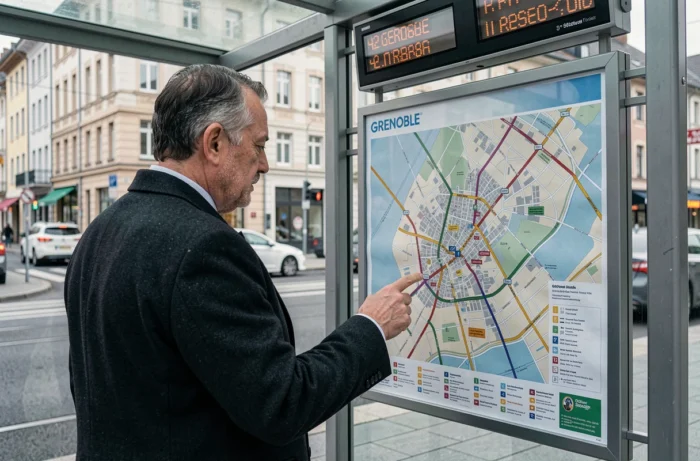
Construction and Disruptions: Adapting Routes in Real Time
The tram network regularly undergoes construction phases related to track maintenance or the securing of infrastructure in the metropolitan area. These projects temporarily alter the routes of certain lines or impose replacement buses on portions of the route.
When a section is closed, the replacement bus service resumes at the main stops, but with extended travel times and often less frequent service. The difference in regularity between a tram on rails and a replacement bus in traffic can reach several minutes per trip.
Tools to Monitor Disruptions
The M réso app and the Mobilités-M website publish real-time traffic alerts. The Transit app, approved by the service, also aggregates updated passing data. Consulting these tools before departure remains the most reliable way to anticipate a delay or a line diversion.
For regular trips, setting up alerts on the lines taken daily allows for receiving a notification as soon as a disruption is reported, without having to check manually.
The Grenoble tram network covers a wide range, from the early hours of the morning until after midnight on weekends, with a mesh of five lines serving university hubs, the station, and neighboring municipalities. Checking the applicable schedule (school or holiday) remains the most useful reflex before each unusual trip.