
The Citroën C2 uses tires whose size and pressure vary depending on the engine type. A 1.1 petrol does not operate with the same settings as a 1.6 i 16V. Choosing the right pressure-size combination directly affects road handling, tire wear, and fuel consumption.
Recommended pressure or maximum pressure: the common confusion about the C2
The sidewall of a tire displays a pressure value. This corresponds to the maximum permissible pressure for the tire itself, not the one recommended by Citroën for the vehicle. Mixing the two remains the most common mistake when inflating.
The pressure to apply is indicated on the label affixed in the driver’s door frame or in the fuel filler flap. The owner’s manual includes these same values. They take into account the weight of the C2, the distribution of masses, and the tire size approved for each engine.
By consulting the tire sizes for Citroën C2, you will find the manufacturer’s values associated with each engine type. Inflating beyond the recommendation does not compensate for an overload: it stiffens the rubber, reduces the contact surface, and degrades braking performance.

Tire sizes according to the C2 engine
Three main sizes equip the C2 depending on the original engine. Each size is linked to a specific load index and speed index, which must be respected during replacement.
| Engine | Tire size | Front pressure | Rear pressure |
|---|---|---|---|
| 1.1 i | 175/65 R14 82T | 2.2 bar | 2.2 bar |
| 1.4 HDi | 175/65 R14 82T | 2.2 bar | 2.2 bar |
| 1.4 i | 185/55 R15 86V | 2.1 bar | 2.2 bar |
| 1.6 i 16V | 195/45 R16 84V | 2.4 bar | 2.4 bar |
The 1.4 i is a special case. It is available in both 175/65 R14 and 185/55 R15 sizes, both of which are approved. The pressures differ slightly from one size to another, which requires checking the corresponding manufacturer values before changing size.
The 1.6 i 16V, reserved for the sporty VTS version, runs on 195/45 R16 with a speed index of V, designed to handle more intense demands.
Decoding tire markings for C2: width, profile, and indices
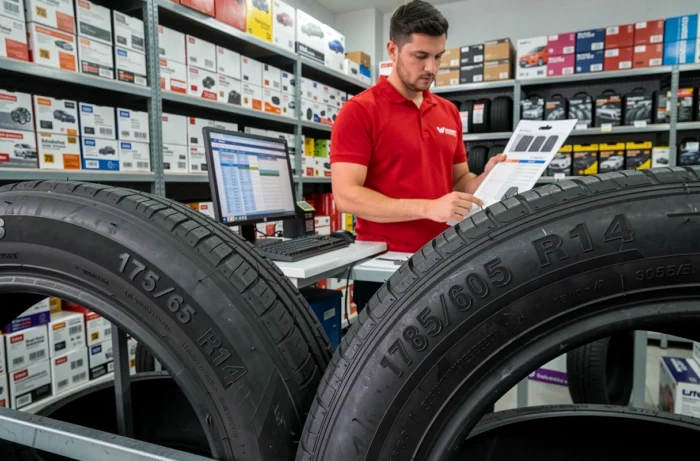
A marking like 175/65 R14 82T contains five distinct pieces of information. Each determines compatibility with the C2.
- 175 corresponds to the width of the tread in millimeters. The higher the number, the more lateral grip the tire offers.
- 65 represents the aspect ratio, called the profile. A profile of 65 means that its height is 65% of the width. On the VTS, the profile drops to 45: steering becomes more precise, but comfort on rough roads decreases.
- R14 indicates a radial structure and a rim diameter of 14 inches. Fitting an R15 tire on a 14-inch rim is physically impossible.
- 82T combines the load index (82) and the speed index (T). Going below the original index results in a failure at the technical inspection.
Switching from a 175/65 R14 to a 185/55 R15 changes the rolling diameter. The difference is slight since both sizes are approved, but the speedometer may show a slight deviation.
Load index and safety
Installing a tire with a load index lower than the original compromises safety, especially when fully loaded or during hard braking. The approved values for the C2 comfortably cover the total authorized weight of the vehicle.
Tire pressure check on the C2: frequency and measurement conditions
Any reliable measurement should be done on cold tires. A tire that has just been driven shows an artificially higher pressure, which skews the result.
A monthly check is the minimum. Before a highway trip or an unusual load (four passengers with luggage), an additional check is necessary. On the C2, the pressures remain the same under normal load and maximum load according to manufacturer data, which simplifies adjustment.
A recurring drop in pressure indicates a fault in the tire or valve. Under-inflation causes premature wear on the shoulders, while over-inflation wears the center of the tread.
All-season tires and 3PMSF marking: a suitable choice for the C2
The European tire label features pictograms that identify tires suitable for winter conditions. The 3PMSF (Three Peak Mountain Snow Flake) marking certifies that the tire has undergone a traction test on snow and meets regulatory requirements.
For a city car primarily used in urban and suburban areas, an all-season tire bearing this pictogram avoids the need to store and mount two seasonal sets. This type of rubber maintains good performance on wet ground and at low temperatures without degrading behavior on dry roads in summer.
The constraint to check: the size as well as the load and speed indices must match Citroën’s recommendations for the relevant engine. An all-season tire in 175/65 R14 82T is suitable for the 1.1 i, provided that the speed index T (or higher) is respected.