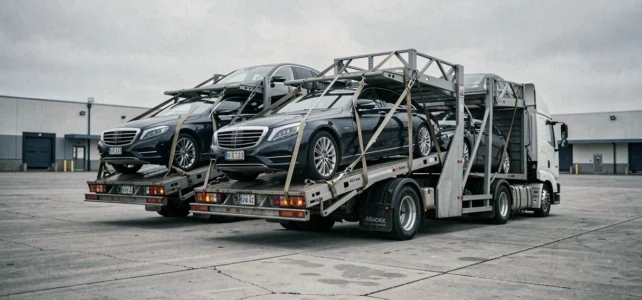
Road transport relies on a regulatory framework that has significantly tightened in recent years, particularly for light commercial vehicles used as transport platforms. Moving a car from one point to another without driving it requires logistical skills, insurance guarantees, and administrative obligations that most individuals and even some professionals underestimate. Understanding these constraints allows one to distinguish between genuinely secure road transport and a simple race for the lowest price.
Professional capacity and regulatory obligations of the transporter
A rarely discussed angle in consumer guides concerns the legal conditions for the transporter’s operation itself. Since the decree of August 2, 2024, access to the professional capacity for light goods transport (vehicles under 3.5 tons) requires a minimum training of 105 hours before the national exam organized by the DREAL. This measure directly targets operators who use light platforms or utility vehicles to move cars.
The tightening goes further. Since July 1, 2026, utility vehicles of over 2.5 tons and up to 3.5 tons used in international goods transport are subject to obligations similar to heavy transport: capacity certificate, designation of a transport manager, enhanced controls. This change affects transporters who deliver vehicles over long distances in Europe using vans or intermediate platforms.
Before entrusting a vehicle, checking that the service provider holds their professional capacity and is registered in the transporters’ registry is a basic reflex. An undeclared operator cannot subscribe to valid transport insurance, making any claim in case of damage legally fragile.

Car transport insurance: what the guarantee really covers
The insurance question remains the blind spot of most quotes. A serious professional transporter offers a so-called “ad valorem” coverage, which compensates the vehicle up to its declared value in case of a claim during transport. This guarantee differs radically from basic professional liability insurance, which often caps compensations at trivial amounts compared to the actual value of a car.
For classic, luxury, or recent vehicles, the choice between an open car carrier and a closed truck with ad valorem insurance fundamentally changes the level of protection. The closed truck protects against projections, bad weather, and limits the risk of theft during intermediate stages. However, its cost is significantly higher, sometimes double that of transport on a standard open car carrier.
When you receive a quote, always ask for a copy of the transport insurance certificate and the compensation limits. If the transporter hesitates to provide this document, it is a clear signal. Evaluating the transport offered by Signal Auto, one can see that transparency regarding guarantees is one of the criteria that separates reliable providers from opaque intermediaries.
Contradictory inventory: proof in case of dispute
Secure road transport does not stop at the journey. The most decisive phase occurs before loading and after delivery. The contradictory inventory, carried out in the presence of the client and the transporter, constitutes the only document that can be opposed in case of damage noted upon arrival.
This document must mention every scratch, impact, deformation, or visible anomaly on the bodywork, rims, glazing, and optics. Timestamped photos usefully complement the written report. Without this inventory signed by both parties, proving that damage occurred during transport becomes extremely difficult.
Points to check during the inventory
- Complete bodywork (panels, bumpers, sills) under sufficient lighting, not backlit or in the rain
- Condition of rims and tires, including the presence of warps or impacts on the sides
- Functioning of openings (doors, trunk, hood) and condition of glazing seals
- Fuel level and exact mileage on the odometer, noted on the document
- Presence of declared interior accessories (removable GPS, mats, spare wheel)
Field feedback varies on the rigor of this step depending on the providers. Some transporters send the inventory in a few seconds, while others use dedicated applications with photos integrated into the file. The difference is measured at the time of dispute.
Open car carrier or closed truck: concrete selection criteria
The open car carrier remains the standard solution for most vehicle transfers. It allows for the grouping of several cars on the same trip, which reduces the unit cost. This method is suitable for common used vehicles, cars for resale, or transfers related to a move.
The closed truck is justified in specific cases:
- Classic vehicle whose value far exceeds that of a standard sedan
- New car delivered to a final customer who demands impeccable condition
- Competition vehicle with fragile aerodynamic elements or special paints
Between these two options, some transporters offer individual tarped platforms, a compromise that partially protects against projections without reaching the cost of a fully closed truck. Available data does not allow for a conclusion on a significant difference in claims between tarped and closed, but protection against theft remains significantly higher in a closed truck.
Non-running vehicles and special cases
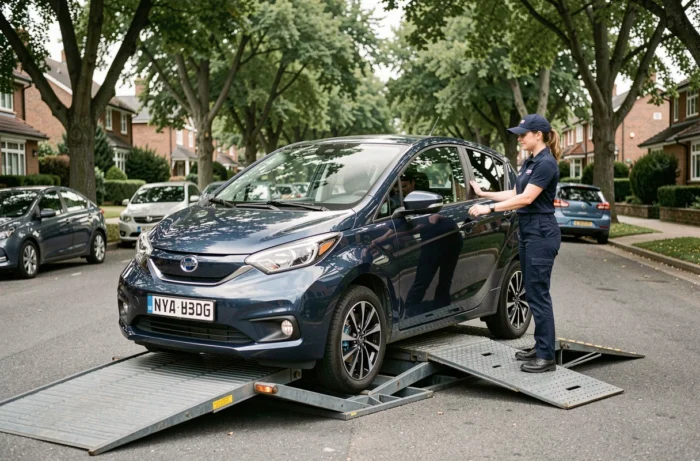
The transport of a broken down, accident-damaged, or without valid technical control vehicle imposes additional constraints. Loading requires a winch or lifting system, which excludes some classic car carriers. The transporter must be informed in advance of the exact condition of the vehicle: locked steering, inoperative brakes, or out-of-service transmission change the loading method and the equipment used.
A vehicle declared running when it is not exposes the transporter to a risk of damage during loading, and the client to a refusal of service on site. Transparency regarding mechanical condition is not an administrative formality; it is a safety condition for the transported vehicle and for the operators on the ground.
The regulatory framework strengthened since 2024 and the increasing insurance requirements push the car transport market towards greater professionalism. For the client, whether individual or professional, checking professional capacity, insurance, and the rigor of the inventory remains the most reliable method to secure the transfer of a vehicle, regardless of the chosen mode of transport.