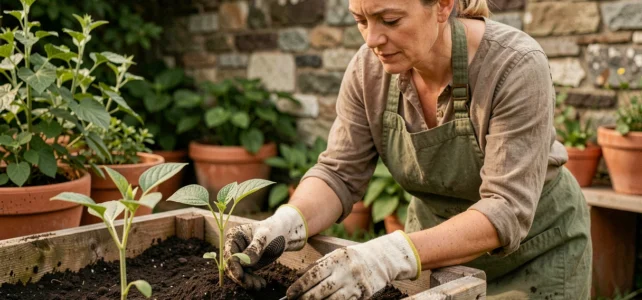
When you plant a perennial bed in September and a prefectural order prohibits watering from mid-June the following year, the question of a garden thriving all year round takes on a different nature. The topic is no longer just aesthetic: it becomes a matter of soil choice, water management, and a planting schedule adapted to real constraints.
Garden and water restrictions: adapting your plantings before watering
In France, ornamental gardens (lawns, flower beds) are now subject to regular watering bans in summer, sometimes throughout the 8 am-8 pm window, or even continuously in areas placed on heightened alert or in drought crisis. Vegetable gardens sometimes benefit from a more flexible regime, with watering allowed very early in the morning or late in the evening, but this privilege disappears in crisis situations.
In practical terms, a garden designed around water-hungry plants becomes unmanageable from July. It is wise to reconsider the plant palette even before thinking about watering. Mediterranean perennials (lavenders, sages, gauras) and ornamental grasses tolerate weeks without water once well-rooted.
A thick mulch at the base of the plantings, made from chipped branches or shredded miscanthus, significantly limits soil evaporation. You can also discover the garden on Le Blog de Coco to explore other concrete landscaping approaches adapted to these constraints.
Rainwater harvesting: what regulations require
Installing a rainwater harvesting tank seems like the obvious solution, but there are regulations to follow. Homeowners who use a domestic well to water their garden must declare it at the town hall (decree 2008-652), under penalty of a fine that can reach 1,500 euros, or even 3,000 euros in case of repeat offenses.
Large harvesting installations connected to the sewage system also require a declaration. For a simple above-ground tank of a few hundred liters, the process remains free, but it will not be sufficient to cover the needs of a large garden in the height of summer.

Living soil and mulching: the foundation of a resilient garden all year round
We often talk about choosing the right plants, but rarely about preparing the soil that will host them. A compacted, bare soil exposed to direct sunlight loses its moisture in just a few days. In contrast, a covered and biologically active soil retains water much longer and nourishes the roots without synthetic fertilizers.
The most reliable method for improving tired soil relies on three cumulative actions:
- Loosening without turning over, using a broad fork or grelinette, to preserve the structure and microbial life of the soil.
- Adding a layer of mature compost (in autumn and spring), which earthworms naturally incorporate into the lower layers.
- Maintaining a permanent mulch, renewed two to three times a year, which protects the soil from frost in winter and heat in summer.
A permanently mulched soil reduces watering and limits weeding. You save time on maintenance and create a favorable environment for beneficial organisms (ground beetles, earthworms, rove beetles) that naturally regulate pests.
Which mulch to choose according to the season
In winter, shredded leaves form a free and effective insulating layer. In spring, they can be replaced with chipped branches, which decompose slowly and enrich the soil with lignin. In summer, wheat or hemp straw, lighter in color, reflects some of the solar radiation and keeps the roots cool.
Feedback varies on the ideal thickness, but below five centimeters, the protective effect remains marginal. We aim for about ten centimeters, ensuring not to pack the mulch directly against the plant stems to avoid collar rot.
Planting calendar: spreading bloom times without multiplying maintenance
A garden thriving all year round does not rely on a single wave of planting in spring. The classic mistake is to fill the beds in April-May with annuals that collapse in August. Spreading plantings over three key periods produces a self-renewing garden.
In autumn (September-November), we install hardy perennials, spring-flowering bulbs (daffodils, crocuses, botanical tulips), and bare-root shrubs. The still-warm soil and autumn rains promote deep rooting before winter.
In late winter (February-March), we add ornamental grasses, aromatic plants, and fruit trees. The soil begins to warm up, the risk of frost decreases, and the plants have all spring to settle in before the heat.
In late summer (August-September), we can still install drought-resistant perennials. Some varieties, like sedums, yarrow, or echinacea, root quickly and bloom as early as the following spring.
Combining flowers, vegetable garden, and shrubs for a productive space
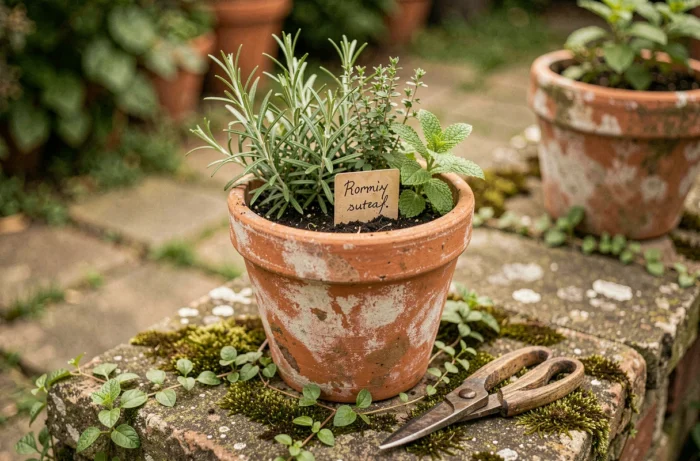
Mixing functions in the same space avoids the “compartmentalized garden” effect where each area lives its own season. A berry shrub (currant, blackcurrant) planted at the back of the bed structures the garden in winter with its silhouette. Aromatics at the edge (thyme, rosemary, chives) remain green almost all year and attract pollinators to the neighboring vegetable garden.
A mixed garden of flowers, vegetable garden, and shrubs requires less maintenance than a strictly ornamental garden, because plant diversity naturally regulates pests and enriches the soil through the variety of root systems.
Seasonal garden maintenance: the actions that truly change the outcome
Rather than a list of monthly tasks, we focus on the three interventions that have the most concrete impact on the garden’s performance throughout the seasons:
- Gentle pruning of shrubs in late winter, before vegetation starts, which stimulates branching and flowering without stressing the plant.
- Cutting back perennials in late autumn (except those whose dry stems protect the crown from frost or feed birds in winter, like echinacea and grasses).
- Targeted weeding in spring, before weeds go to seed, which halves or thirds the weeding time for the rest of the year.
Leaving grasses standing all winter offers an often underestimated visual interest: frosted or blown by the wind, they provide volume and texture to the garden during the empty months.
The garden that thrives all year is not the one where you intervene the most, but the one where each action occurs at the right moment. Living soil, plants adapted to local water restrictions, and a planting calendar spread over three seasons form a more reliable foundation than any decorative trick.