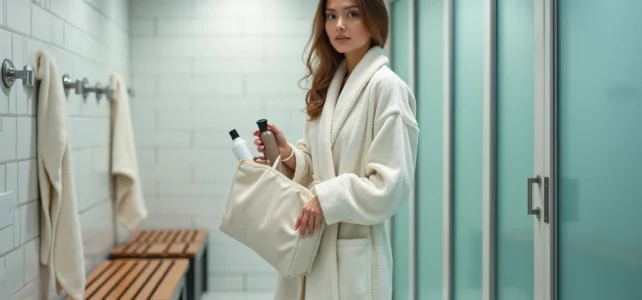
Shared showers refer to sanitary spaces shared among several travelers, usually located outside of rooms or dormitories. In most hostels, these showers take the form of individual closed cabins, arranged in a room accessible to all occupants of a floor or building. The configuration varies by establishment, but the principle remains the same: the shower space does not belong to a particular room.
Before leaving with a distorted image of what awaits you, it is worth understanding how these facilities actually work, what has changed in recent years regarding hygiene, and what you can do to ensure the experience remains comfortable.
Closed cabins, curtains, or partitions: what you will actually find
The word “shared” might suggest a large open room where everyone showers side by side. The reality is almost always different. Most hostels offer individual shower cabins with locks, separated by partitions that go from floor to ceiling or nearly so. Some older or more basic facilities use curtains, but this scenario is becoming rarer in recent urban hostels.
Several hostels also have showers integrated directly into the rooms or dormitories. This is a criterion you can check when booking: booking platforms usually specify whether the bathroom is private, shared within the room, or located on the floor.
Regarding whether shared showers in hostels pose a real privacy issue, the answer largely depends on the generation of the establishment. Recent hostels invest in spacious cabins with hooks, dry benches, and adequate lighting. Older ones may be limited to a showerhead, a curtain, and a tiled floor without a dry separation.

Hygiene of shared showers: standards and cleaning reality
The most commonly cited health risk concerns fungal infections and warts, favored by shared damp floors. This risk exists, but it is the same as that of a public swimming pool or a gym locker room. Wearing shower flip-flops is sufficient in the vast majority of cases to protect against it.
On the operator side, regulatory constraints have evolved. In Europe, collective accommodations (hostels, lodges, holiday centers) face increased requirements regarding the treatment of gray water, meaning water from showers and sinks. Some facilities use phytoremediation systems or biological treatment with regular checks of the quality of the discharged water.
In practice, a well-managed hostel cleans its showers at least twice a day, with a thorough cleaning daily. Establishments affiliated with recognized networks (HI France, YHA, for example) apply standardized cleaning protocols. The frequency and quality of cleaning remain the determining factor: a shared shower cleaned three times a day is more hygienic than a hotel private bathroom cleaned once.
What should raise alarms upon your arrival
- Black or moldy grout over a large area, indicating insufficient maintenance for a long time
- Absent or non-functional ventilation in the shower room, promoting the proliferation of mold and bacteria
- The absence of a trash can or soap dispenser, indicating a minimal level of management of the sanitary space
- Water that does not heat up or takes several minutes to reach a proper temperature, a common problem during peak hours in undersized facilities
Showers in hostels in countries where drinking water is limited
The issue changes nature when you travel to countries where access to drinking water remains partial. In Madagascar, for example, just over half of the population has access to a source of drinking water. In Cambodia or Nicaragua, consular authorities remind that tap water should not be considered potable by default.
In this context, shared hostel showers do not present an additional risk compared to a private shower: the water comes from the same network. The basic precaution is to avoid swallowing water while showering and not to wash an open wound under the tap without disinfectant.
Some hostels in tropical areas operate with tanks supplied by tanker trucks. Pressure may be low, the water cold, and availability limited to certain hours. This is not a hygiene issue but a comfort one, and it concerns both private rooms and shared spaces.

Shower kit in a hostel: accessories that change the experience
Rather than fearing shared showers, prepare for them. A few accessories can transform a chore into a neutral or even pleasant moment.
- Shower flip-flops: the basic protection against fungal infections, to slip into a plastic bag after use to avoid wetting the rest of your belongings
- A quick-drying microfiber towel, which takes up little space and does not stay damp for hours in your bag
- A toiletry kit with an integrated hook, which you can hang in the cabin instead of placing it on a wet floor
- A padlock for your locker, as shower time is when your belongings are left unattended in the dormitory
Most hostels do not provide towels or shower gel (unless stated otherwise at booking). Assuming that nothing will be provided avoids any unpleasant surprises.
Managing peak hours
The time slot between 7 AM and 9 AM sees the majority of showers in a hostel. If you can manage to wake up a bit earlier or shower later in the morning, you will find the cabins free, hot water available, and the floor cleaner. The same observation applies in the evening between 6 PM and 8 PM, when travelers return from their outings.
Shared showers in youth hostels do not pose any particular health issues in a well-maintained establishment. The only real comfort criterion is the quality of management of the hostel, not the shared nature of the space. Reading recent reviews before booking, checking for the presence of closed cabins, and bringing your shower flip-flops cover the essential precautions.