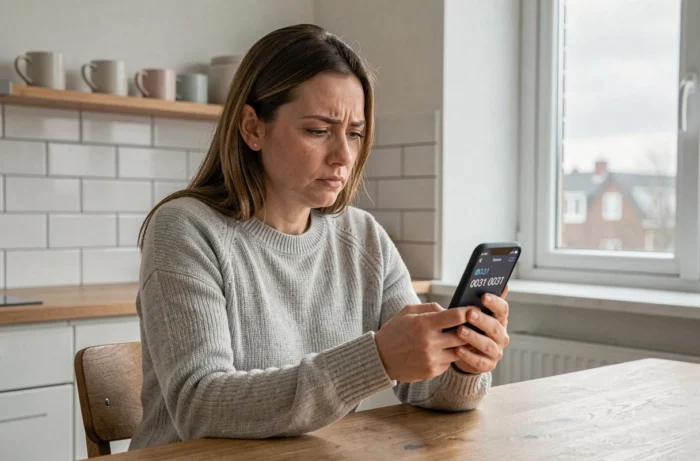
The prefix 0031 (or +31) corresponds to the international dialing code for the Netherlands. Receiving a call from this number does not automatically indicate a fraud attempt, but reports of scams using this code are increasing in France. With the implementation of new rules on telemarketing in August 2026, the legal framework has changed. This article compares legitimate and fraudulent calls in +31, then analyzes what the recent legislation concretely changes for individuals.
Call in 0031: legitimate code or scam signal, sorting criteria
| Criterion | Legitimate call (+31) | Fraudulent call (+31) |
|---|---|---|
| Origin | Company or contact based in the Netherlands | Number spoofed via spoofing (real location unknown) |
| Context | You are expecting a call (reservation, supplier, acquaintance) | Unsolicited call, no prior connection |
| First contact | Identified human voice, clear subject | Automated message or silence, then redirection |
| Request made | No sensitive data requested by phone | Request for bank details, code received by SMS, callback to a premium number |
| Complementary channel | Verifiable email or mail in parallel | No written trace, pressure to act quickly |
The technique of spoofing allows a fake code to be displayed on the recipient’s screen. A call displayed in +31 can therefore originate from any country.
To recognize a number in 0031 at the first ring, the most reliable reflex remains to check if you have an active link with the Netherlands. Without obvious context, it is better to let it ring and search for the number online before any callback.

Law of August 11, 2026 on telemarketing: what changes for calls in +31
Since August 11, 2026, commercial B2C telemarketing is prohibited without the explicit prior consent of the consumer, in accordance with law n° 2025-594 of June 30, 2025, and decree n° 2026-662 of July 23, 2026. France has shifted from an opt-out system (registration on Bloctel to refuse) to an opt-in system.
This shift has a direct consequence on calls in 0031. A commercial call from abroad, including from the Netherlands, targeting a French individual who has not given any prior consent is now illegal in principle.
Conditions for valid consent
The text imposes strict requirements on proof of consent:
- The agreement must be free, specific, informed, and unequivocal, manifested by a positive act (checked box, signed form). Simple silence or absence of refusal does not count.
- The professional must timestamp and keep proof of this consent for several years.
- The consumer can revoke their agreement at any time, without justification or cost.
In practice, the vast majority of unsolicited commercial calls in +31 received by a French individual fall under this prohibition. Scam is no longer the only reason to be cautious: even “honest” telemarketing without your written consent is against the law.
Sanctions faced by offending companies
Companies that do not comply with the new framework face financial penalties. This threat applies to structures based in France, but operators located outside the European Union remain difficult to pursue. This is precisely where the issue lies for spoofed calls in +31 originating from third countries.
Task scam and other fraudulent scenarios via +31
The most reported type of fraud with the +31 code is the so-called “task scam.” The scenario follows a recognizable pattern:
- A message (SMS or call) offers a simple and paid job, often related to online reviews or “missions” on a platform.
- The first tasks indeed yield small amounts to build trust.
- The victim is then invited to “invest” to unlock larger gains, only to lose the money advanced without any possibility of recovery.
- Exchanges quickly move to private messaging (WhatsApp, Telegram) to escape any traceability.
Other variants exist: fake technical support, identity theft, or callback to a premium number. The common point remains the time pressure and total lack of official written trace.
Reporting and blocking: concrete tools against suspicious calls in 0031
Blocking a number on your phone is not enough to stop the phenomenon, as scammers regularly change the displayed number. Several complementary actions increase protection.
Reporting to 33700 (by SMS) remains the official channel for voice spam and fraudulent SMS. It feeds the database used by operators to filter reported numbers.
Registering on Bloctel retains legal interest (proof of refusal of telemarketing), but does not technically block fraudulent international calls. Individual vigilance remains essential as a complement.
Call filtering applications offered by operators or third-party publishers identify numbers reported by the community. They reduce the volume of unwanted calls without completely eliminating them, as spoofing constantly renews the displayed numbers.
The shift to opt-in since August 2026 should gradually reduce the volume of legal commercial calls. Calls that persist despite this framework are, by definition, either illegal or fraudulent. This simplification facilitates sorting: an unsolicited commercial call in +31 has no possible legitimacy without proof of prior consent.