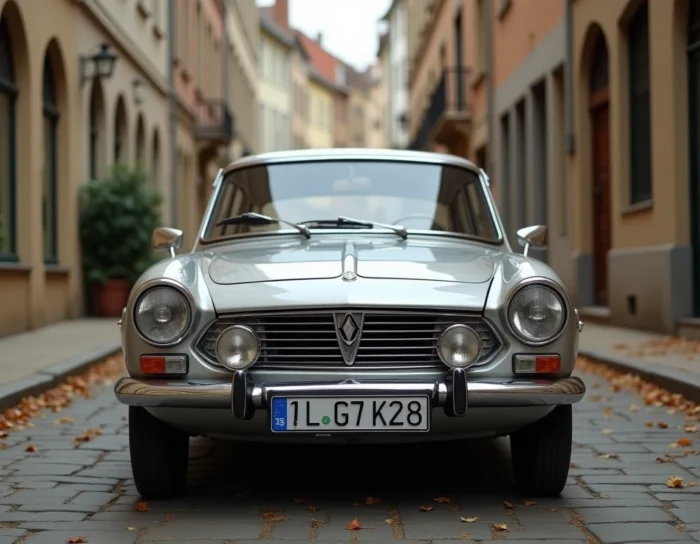
The Renault 30 is often presented as the large French touring car equipped with a PRV V6. Few sources explain why this engine adopts such a particular architecture, nor what connection it has with an abandoned V8 project that was shelved even before mass production. Understanding the technical specifications of the Renault 30 requires tracing back to this mechanical origin, which conditions both the performance, the road behavior, and the limits of the model.
From the Peugeot-Renault V8 project to the PRV V6: an inherited architecture
Before the Renault 30 came to life, Peugeot and Renault were working together on a high-end model aimed at competing with the Citroën DS. This program, known as Project H, planned for a 3.5-liter V8 with two double-barrel carburetors, paired with a 4-speed manual transmission and rear-wheel drive.
Project H was officially abandoned in early 1967. However, the 90° mechanical layout of the V8 did not disappear: it was preserved and adapted to give birth to the PRV V6 (Peugeot-Renault-Volvo). This direct lineage explains the atypical 90° angle between the two rows of cylinders of the V6 in the Renault 30, whereas a V6 designed from scratch typically adopts a 60° angle.
Enthusiasts who wish to discover the technical specifications of the Renault 30 V8 will find this mechanical peculiarity, which directly influences the engine’s balance and the vibrations felt at certain RPMs.
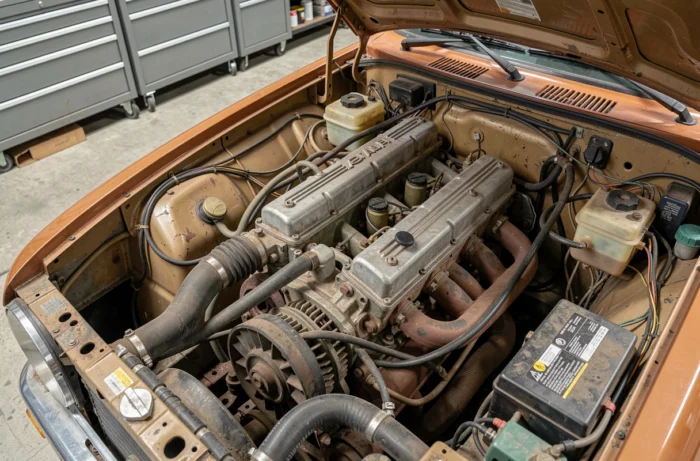
Comparative technical specifications of the Renault 30 TS and TX versions
The Renault 30 was produced between 1975 and 1983, with 136,403 units assembled in France. Two main versions stand out by their equipment level and engine settings.
| Feature | Renault 30 TS (1975) | Renault 30 TX (1978) |
|---|---|---|
| Engine | PRV V6 2,664 cm³ | PRV V6 2,664 cm³ |
| Architecture | 90° V6 | 90° V6 |
| Fuel System | Carburetor | Injection |
| Transmission | 4-speed manual / 3-speed automatic | 5-speed manual / 3-speed automatic |
| Driving Wheels | Front-wheel drive | Front-wheel drive |
| Wheels | Steel | Aluminum |
| Class | Touring | Touring |
The transition from the TS version to the TX marks a technical turning point. Injection replaces the carburetor, the manual transmission gains a fifth gear, and aluminum wheels become standard. The TX version, presented at the Paris Motor Show in 1978, also received a distinctive chrome central foot.
90° PRV V6 engine: technical consequences on driving
The 90° angle inherited from the V8 project has concrete implications. A 60° V6 benefits from a natural balancing of inertial forces, giving it a characteristic smoothness. A 90° V6 generates additional vibrations that require counterweights on the crankshaft to compensate for imbalances.
In the Renault 30, this architectural choice results in a slightly rougher operation at low RPMs compared to a classic six-cylinder. On the other hand, the width of the 90° block allowed the engine to be integrated into a compartment designed for front-wheel drive, an unusual configuration for a touring car in this segment at the time.
This PRV V6 had a career well beyond the Renault 30: Peugeot, Volvo, and even some sports car manufacturers used it in various forms for over two decades.
Mechanical developments over the years
The engine’s fuel system was modified starting in the 1977 model year, with a reduction in power for the TS version. The 1979 model year marks a reversal of this trend: power is increased again. On the automatic version, electronic ignition appeared as early as 1978.
- Model year 1977: modification of the fuel system, new door handles, and redesigned fuel filler flap
- Model year 1978: revised dashboard, exterior mirror adjustable from the inside on the TS
- Model year 1979: launch of the TX with injection and 5-speed manual transmission, rear seat belts, and fog light
- Model year 1981: arrival of the Turbo Diesel version with an engine from Française de Mécanique
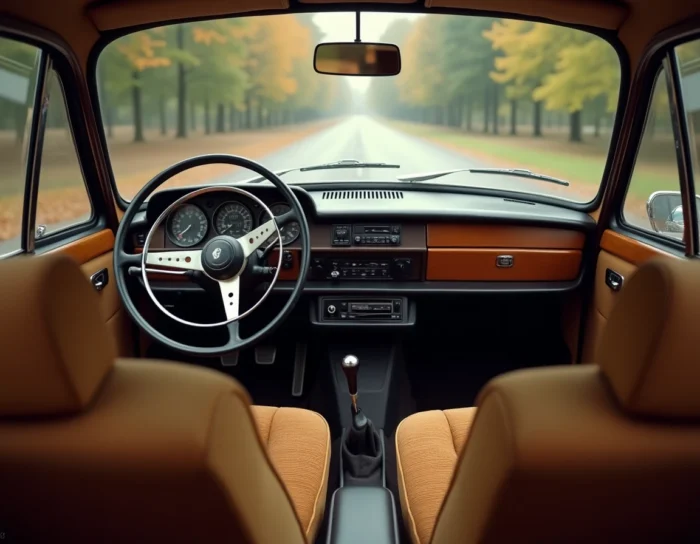
Renault 30 in the collector’s market: a status report
With total production below 140,000 units over eight years, the Renault 30 was never a massive commercial success. The lack of a specific body style hurt it from its launch: the hatchback design, shared with the cheaper Renault 20, blurred its high-end positioning against Peugeot and Citroën.
Well-preserved examples have become rare. The model, however, benefited from late media exposure, notably through cinema. François Mitterrand, among other political figures, chose this touring car, giving it a special status in the history of French automobiles.
For enthusiasts looking for a Renault 30 today, the main challenge remains sourcing specific parts for the PRV V6, particularly the injection components of the TX version. Available listings in France can be counted on one hand, and the condition of the engine largely determines the resale value.
The Renault 30 remains a case study in the French automotive industry: a technically ambitious car, powered by an engine with a unique history, but penalized by positioning choices that limited its success. Its technical specifications, marked by the legacy of the V8 project and the 90° architecture of the PRV V6, make it a model that collectors are rediscovering with fresh eyes.